
How to Learn a Language with Online Radio: 8 Practical Tips
October 22, 2026 · Updated November 02, 2026
Radio is one of the easiest ways to hear a language as native speakers really use it. You get natural speed, current vocabulary and regional accents, and it costs nothing. The trick is to listen with a plan rather than just letting it run in the background.
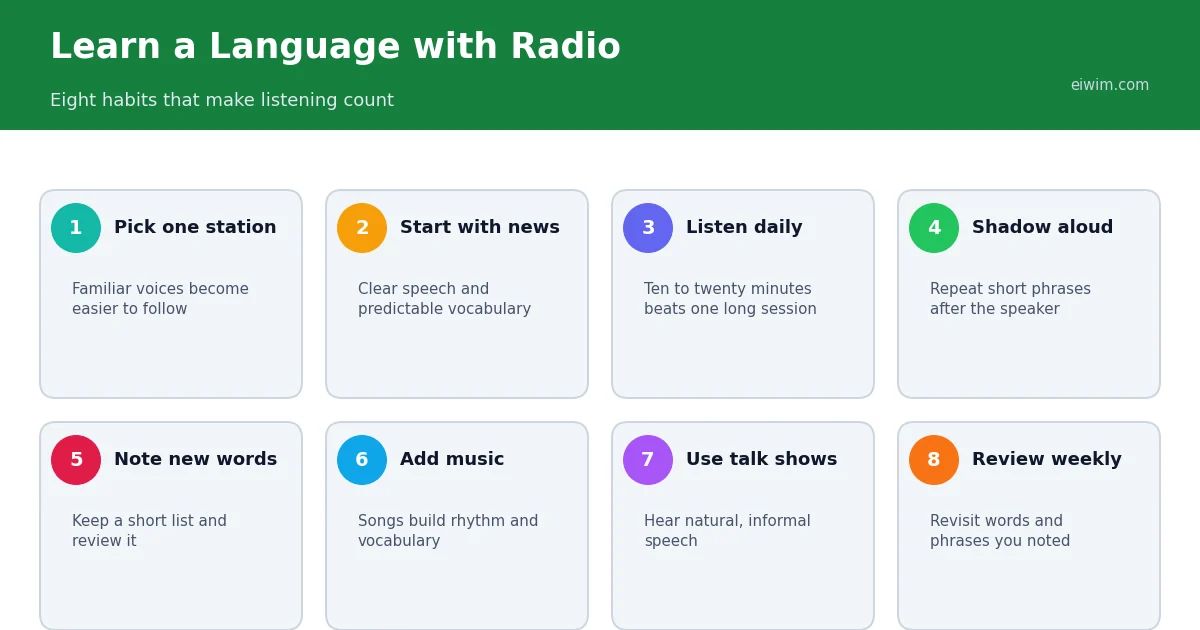
1. Choose the right language and station
Browse the languages page and pick stations in the language you are learning, for example Spanish, German, French or Italian. Stay with one or two stations at first so the presenters' voices and the usual programme structure become familiar.
2. Begin with news
News bulletins use clear, standard pronunciation and a limited set of topics, which makes them forgiving for learners. Stations in the News-Talk category are a good starting point. Because the same stories repeat through the day, you hear key words several times.
3. Listen often, in short sessions
Ten to twenty minutes a day is more effective than a single long session each week. Put the station on while you cook or commute, and treat it as a habit.
4. Shadow what you hear
Shadowing means repeating a short phrase aloud just after the speaker. It trains your ear and your mouth together. Choose a sentence you understand, pause or wait for the next one, and copy rhythm and intonation as well as the words.
5. Keep a tiny vocabulary list
You will hear words you do not know. Note three or four per session, look them up afterwards, and review the list at the end of the week. Do not try to catch everything; understanding the gist is a real achievement.
6. Use music as well
Songs repeat vocabulary and teach rhythm. Try pop stations in your target language, such as those in the Pop genre, and look up lyrics you are curious about.
7. Move on to talk shows
Once news feels comfortable, try discussion and interview programmes. Natural conversation includes interruptions, fillers and informal expressions that textbooks rarely teach.
8. Review weekly
Look back at your word list and try to use a few words in a sentence. If you can pick a favourite show and follow its main points, you are making progress.
A realistic expectation
Radio will not replace lessons or conversation practice, but it builds listening skill and confidence between them. For a wider view of how to explore stations, see our guide to discovering music through online radio.
Choosing a language and where to start
Different languages suit different approaches. English offers the largest range of stations and accents, which is good if you want to practise listening to varied speakers. Spanish has a huge number of stations across Spain and Latin America, with clear pronunciation that many learners find approachable. French is broadcast in Europe, Canada and parts of Africa, and each region has its own accent. German has clear public radio and a large selection of music stations. You can browse each on the languages page, for example English, Spanish, French or German. Pick the language you already study or need most, and choose one station to follow for a few weeks before switching.
Make notes that you will actually use
A notebook turns passive listening into learning. Draw three columns: the word or phrase you heard, what you think it means and the source, such as the station and time. After listening, look up each item and add the confirmed meaning. Once a week, cover the meaning column and test yourself. Keep the list short, because five or ten items you really remember are better than fifty that you forget. Group words by topic, such as weather, sport or politics, since radio programmes repeat the same vocabulary within a topic, and that repetition helps memory.
Common problems and how to solve them
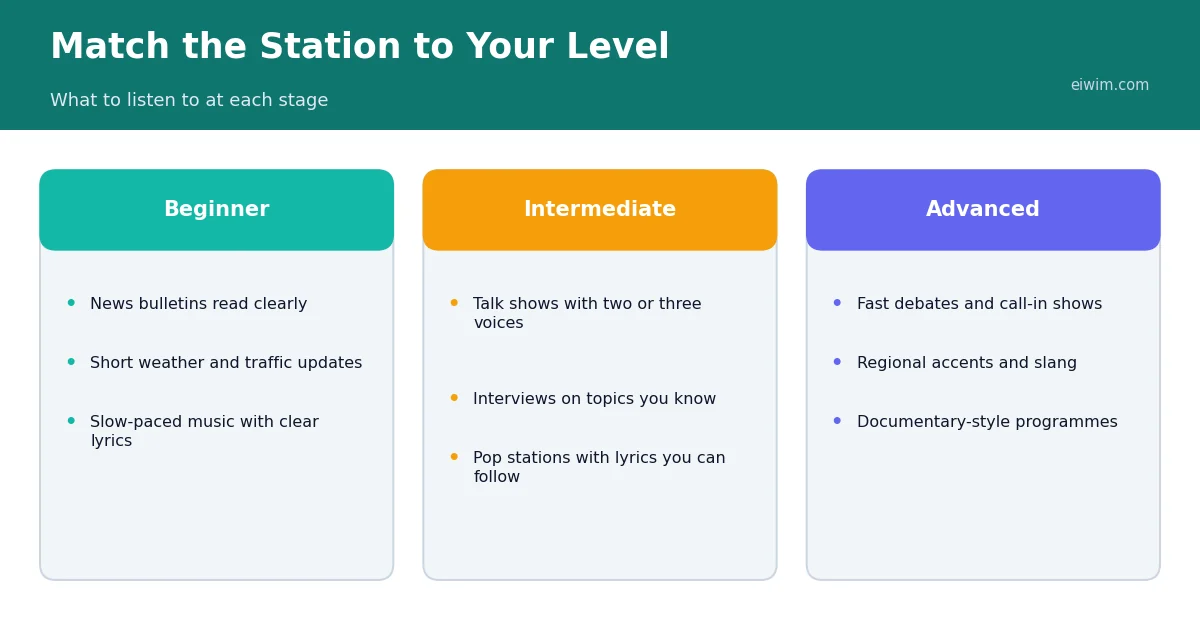
- It is too fast. Move to a slower format, such as a news bulletin read carefully, or a children's or learners' programme if one is available.
- I can't recognise words I know. Spoken language joins words together. Listen to short segments several times and try to repeat them aloud.
- Accents confuse me. Listen to stations from different regions to get used to variety, but start with one accent first.
- Slang is hard. Music and talk shows use slang that textbooks avoid. Do not worry about every term, and note the ones you hear repeatedly.
- I lose motivation. Mix serious listening with enjoyable music, and set a small daily time, such as ten minutes.
Combine radio with other study
Radio works best with reading and speaking practice. If you are following a course, use the radio to hear the vocabulary of each unit in real life. Read a news article on the same topic that you heard on the radio to see the written form. Speak aloud along with a presenter to practise rhythm. If you can, find a conversation partner to talk about what you heard. For ideas on news-based practice, see our guide to finding reliable news and talk stations.
Measure your progress
Progress in listening is gradual, so use simple checkpoints. At the start, note how much of a one-minute bulletin you understand, on a scale from nothing to most words. Repeat the test every month using a similar bulletin. You will likely notice that familiar phrases stand out more clearly and that you can follow the general topic even when you miss details. Celebrate these small improvements. If you want music practice, try the genres you already like, such as Pop or Rock, in your target language.
A sample week of practice
To make a plan easy to follow, here is a sample week. On Monday, listen to a ten-minute news bulletin and note five new words. On Tuesday, repeat the same type of bulletin and try to recognise the words you wrote down. On Wednesday, listen to a music station and choose one song to look up lyrics for. On Thursday, listen to a short talk segment and write one sentence summarising it. On Friday, review your list and test yourself. At the weekend, relax with a longer programme and enjoy it without taking notes. Repeating a simple weekly pattern like this builds habit and confidence much more reliably than irregular bursts of effort.
Quick answers
Do I need to understand everything I hear?
No. Aim for the main idea. Catching a few words and the topic is real progress.
How long should I listen each day?
Ten to twenty minutes of focused listening beats a long, distracted session.
Is radio enough to learn a language?
It builds listening skill, but combine it with lessons, reading and speaking practice.