
How to Discover New Music Through Online Radio
October 31, 2026 · Updated November 02, 2026
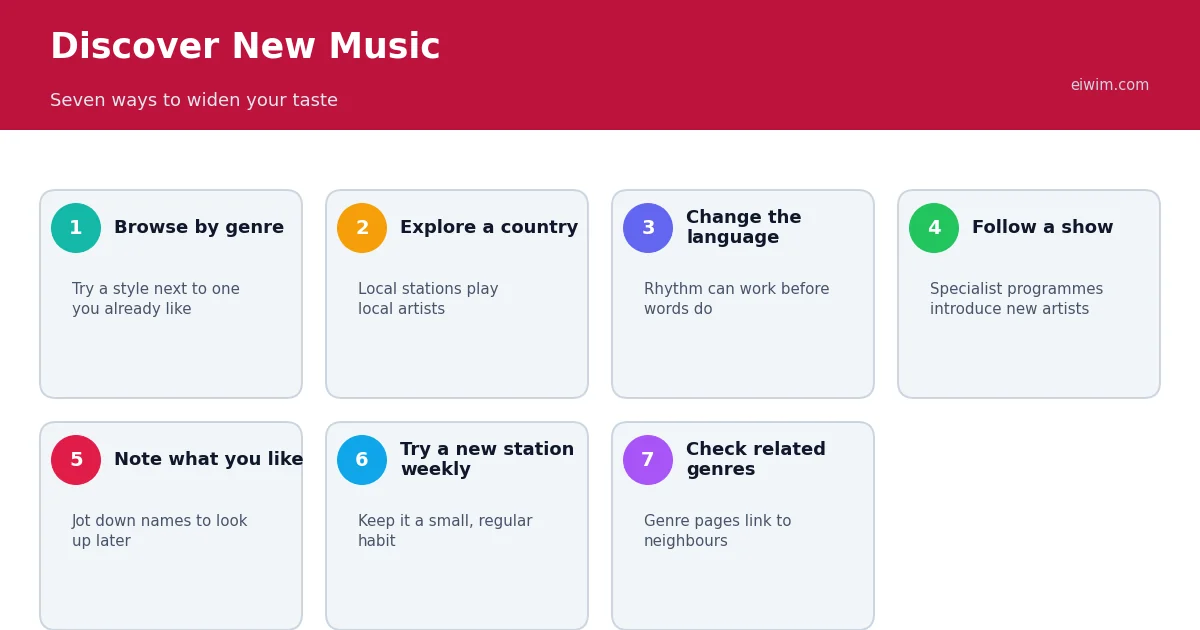
Streaming services recommend music based on what you have already played, which is comfortable but narrow. Radio works differently. Presenters and programmers choose what airs, and you meet songs you would not have searched for. Here are practical ways to use that for discovery.
1. Start with what you know, then step sideways
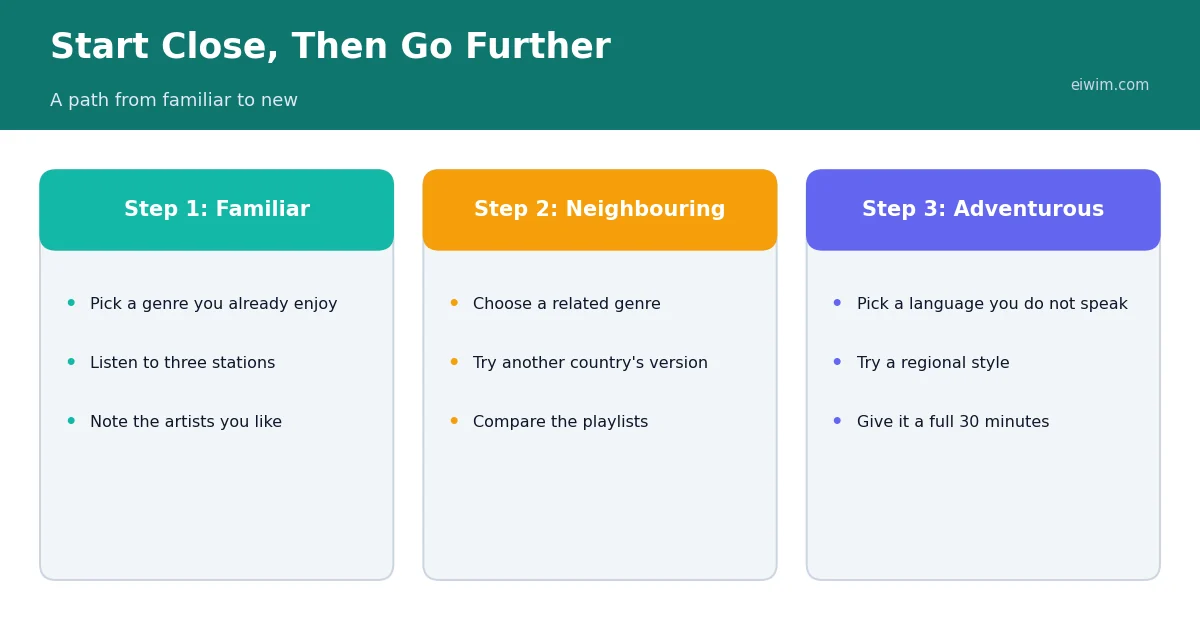
If you love pop, try a station tagged with a neighbouring style. Genre pages on Eiwim link to related genres, which makes this easy. A fan of Rock might sample Alternative or Indie, while someone who likes Jazz could try Blues or Soul.
2. Let a country introduce you
Local stations play local artists, many of whom rarely appear on international playlists. Pick a country from the countries page and listen for half an hour, for example Germany, France, Mexico or Canada.
3. Try a language you do not speak
You do not need to understand the lyrics to enjoy the rhythm, melody and mood. Browse the languages page for something unfamiliar. If you do want to learn the language, our guide to learning a language with online radio shows how.
4. Follow specialist shows
Many stations run genre or artist-led programmes at set times. They are often presented by enthusiasts who explain the music and name the tracks, which is ideal for discovering new artists.
5. Keep a short list
When a song grabs you, write down the artist and title, or use a music-recognition app on your phone. Look them up later. A list of five names a week soon turns into a library.
6. Make it a small habit
Try one new station a week, and give it at least 20 or 30 minutes before you judge it. First impressions of an unfamiliar style are often wrong.
7. Explore the roots of a genre
Many styles have an origin story. If you like electronic music, our guide to house, techno and trance explains how they differ. If you like reggae, see how reggae grew out of ska and rocksteady.
A note on quality and choice
Live radio is also a good reminder that taste can change. Do not worry about disliking a station; skipping on is part of the process. The point is to expose yourself to more than an algorithm would.
Use presenters and request lines
Presenters are guides. A good music show host explains why a song matters, introduces artists and connects tracks, which gives you context that a playlist cannot. Look for shows with a clear theme, such as new releases, a particular decade, a regional scene or a single genre. Many stations also take requests and play listener suggestions, which can reveal music you would not find alone. When a presenter mentions a name or title you like, write it down immediately and look it up afterwards. Over a few weeks you will build a personal list that grows more varied.
Create a simple discovery log
A discovery log does not need to be elaborate. A note on your phone with four columns is enough: artist, song, station and your rating from one to five. Add something each time you hear a track you like. Once a week, listen to your top-rated songs again and look for patterns. You may notice that you like a certain tempo, instrument or decade, which helps you choose your next station. Over time the log becomes a map of your taste, and you can use it to search for similar stations in the genres list.
Follow a genre map
Music styles are linked in chains, and following a chain is one of the best ways to discover. If you enjoy Jazz, try Blues, which shares its roots, then Soul, which grew from blues and gospel, then Funk, and then HipHop, which borrowed from funk. If you like Rock, follow it back to Classic Rock and Rock'n'Roll, or forward to Alternative and Indie. If you like House, explore Techno and Trance. Each step brings new artists with a familiar feel. Our posts on blues and soul and Motown show how some of these links work.
Beyond radio: using what you find
Once you discover an artist, you can explore further outside the radio. Look for their other songs and albums, read about their influences and find live recordings. Share your discoveries with friends, who may introduce you to music in return. Some listeners also keep playlists that mix their radio discoveries with older favourites. The radio remains the starting point, offering fresh surprises that algorithms sometimes miss, because humans choose the music and put it in context.
Avoid the echo chamber
It is easy to stay with what you already like, especially if you find a station that suits you. To avoid this, set a small rule: once a week, listen to a station from a genre or country you have never tried. Pick randomly from the countries page, listen for twenty minutes and note one thing you liked. Even if the music is not your style, you will often hear a technique or instrument that sparks a new interest. Over a year, these small experiments can widen your taste a great deal.
Discovering music in other languages
Music from other countries can be the most rewarding source of new sounds. You do not have to understand the lyrics to enjoy a melody, a groove or a voice. Try a Portuguese-language station for Brazilian styles, a Spanish station for Latin pop and salsa, or a French station for chanson and French hip hop. Presenters often introduce songs briefly, and the music itself does the rest. If you find an artist you enjoy, search for translations of their lyrics later to understand what they sing about. You can browse by language to find a station for any of these.
Quick answers
How do I find the name of a song I hear?
Check the station's now-playing display, or use a music-recognition app on your phone.
How long should I give a new station?
Try at least 20 to 30 minutes before deciding. First impressions of an unfamiliar style can be misleading.
Do I need to speak the language to enjoy foreign stations?
No. Rhythm, melody and mood work across languages.