
News and Talk Radio: How to Find Reliable Stations
October 07, 2026 · Updated November 02, 2026
Radio is one of the fastest and easiest ways to follow the news. You can listen while you work, cook or travel. Online radio adds a new advantage: you can hear stations from many countries and compare how different broadcasters cover the same events. But with more choice comes a need to judge what you are hearing. This guide explains how to find reliable news and talk stations and how to listen critically.
News, talk and analysis are different things
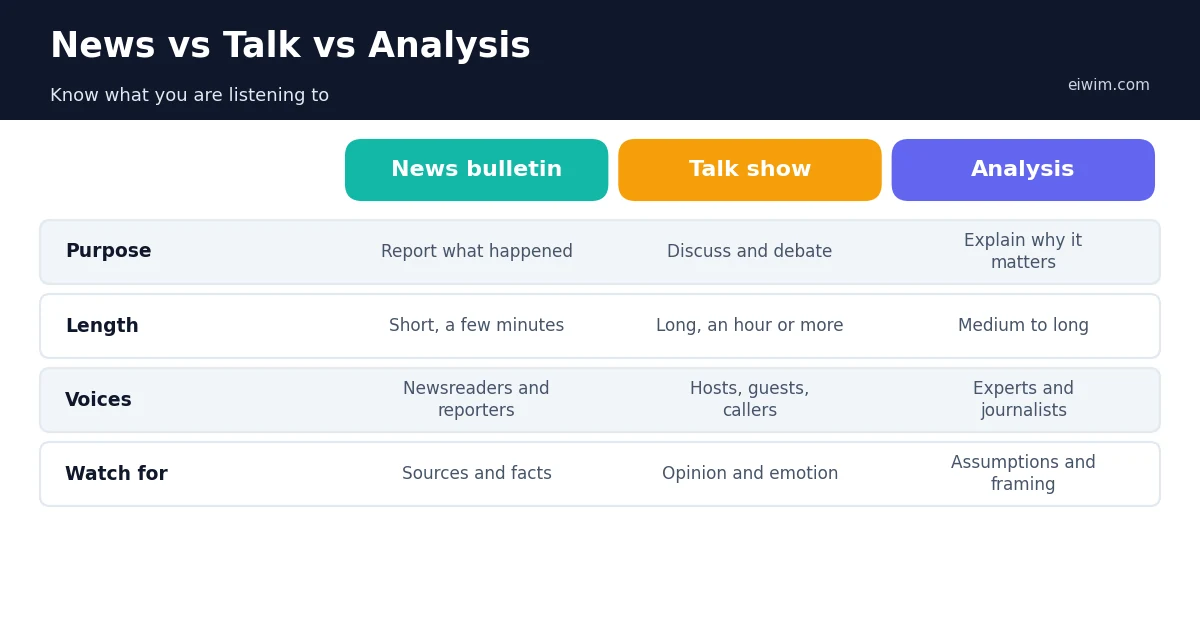
The first step is to separate three kinds of programme that are often mixed together.
- News bulletins are short summaries of what has happened, usually read by a newsreader and often broadcast on the hour. They aim to report facts rather than opinions.
- Talk shows feature a host, guests and sometimes callers. They are built around discussion and opinion, and the host's views often shape the conversation.
- Analysis and documentaries take a longer look at a topic, explaining background and causes.
Problems often arise when listeners mistake a talk show for a news bulletin. A host stating a strong view is not the same as a reporter confirming a fact. If you are not sure which you are hearing, listen to how the programme describes itself and how it handles evidence.
Who runs the station?
Ownership and funding do not decide whether a station is accurate, but they help you understand its perspective.
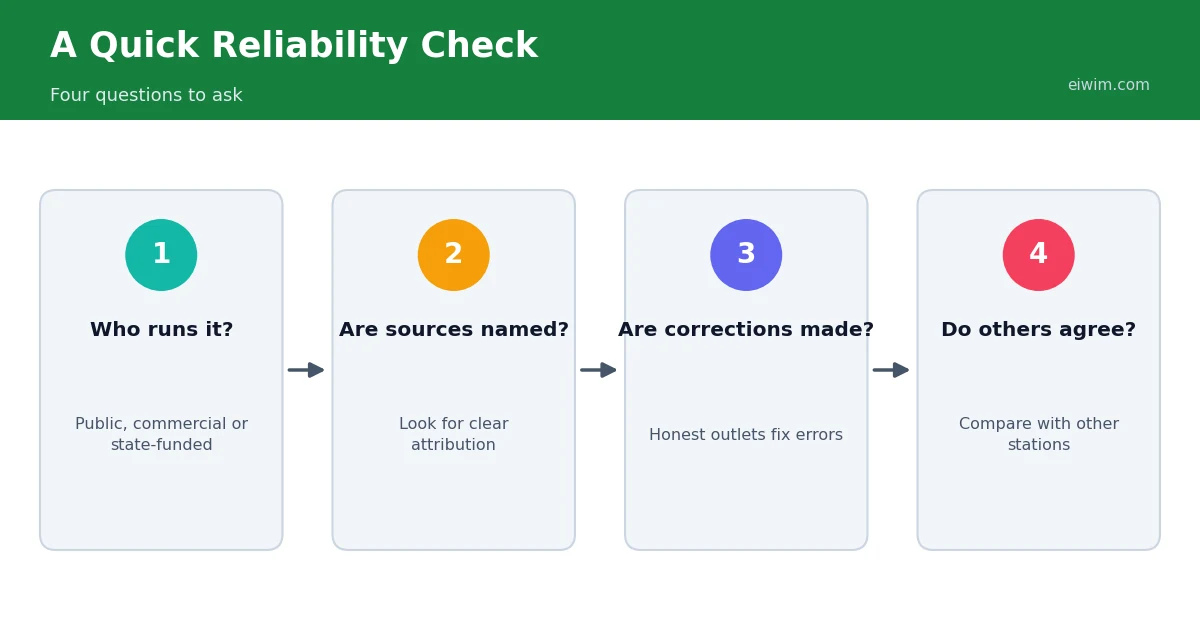
- Public broadcasters are funded by the public, through taxes, licence fees or similar systems, and are usually required to be impartial. Examples include national broadcasters in many countries.
- Commercial stations are funded by advertising. They may have excellent journalism, but they also need to attract large audiences.
- State-funded international services are paid for by a government and may emphasise that government's viewpoint.
- Community and independent stations are often run by volunteers and may serve a specific area or group.
None of these is automatically right or wrong, but knowing which one you are hearing helps you weigh what is said. Most stations explain who owns them on their website.
Signs of a reliable station
- Clear sourcing. Reports say where information comes from, such as an official statement, a named expert or an eyewitness.
- Separation of fact and opinion. Opinion segments are labelled, and hosts distinguish what is known from what they believe.
- Corrections. Reliable outlets admit mistakes and correct them, on air or in writing.
- Balance. Important disagreements are presented fairly rather than in a single direction.
- Consistency. Over time, the station's reporting matches what other reliable sources report.
Warning signs
- Claims without any source or with vague sources such as "people are saying".
- Highly emotional language designed to provoke anger or fear.
- Presenting a single story as proof of a general trend.
- Refusing to acknowledge any alternative view.
- Breaking news stated as certain before facts are confirmed. Early reports are often corrected.
Build a balanced mix
No single source is complete. A simple habit is to follow two or three stations with different backgrounds. You might choose a national public broadcaster from your own country, an international broadcaster from another region and one local station. On Eiwim, you can find stations in the News-Talk and Talk categories, and you can narrow your search by country or language. For example, you can browse the USA, Germany or France for different perspectives.
Listening in other languages
News is a good way to practise a language because bulletins use clear, careful speech. If you are learning, try a bulletin in your target language and then read the same story in your own language to check your understanding. Our guide to learning a language with online radio explains this in more detail.
Dealing with breaking news
When an event is happening, the first reports are the least reliable. Details change, numbers are revised and rumours spread quickly. A sensible approach is to treat early information as provisional, wait for confirmation from more than one source and be wary of dramatic claims. Radio can be valuable here, because live bulletins are updated as facts become clear, but you should still listen for the language of uncertainty, such as "reportedly" or "unconfirmed".
Mind your time zone and your data
If you listen to stations from other countries, remember that their schedules follow local time. A morning programme in Berlin may play in the middle of the night where you are. Speech is also easy on data. A news stream at 64 kbps sounds clear and uses only about 28.8 MB per hour. Our guide to bitrate and stream quality explains why.
A simple weekly routine
You do not need to listen all day to stay informed. A short routine works well. In the morning, listen to one news bulletin from a station you trust to get the main headlines. During the day, if you have time, listen to one longer programme on a topic that matters to you. In the evening, choose a second station from a different background and note whether it emphasises different stories. Once a week, pick a story that you followed and see how its coverage changed from the first report to the latest information. This habit builds your sense of how stories develop and which sources are careful.
Protecting your attention
Constant news can be tiring. If you find that talk radio makes you anxious or angry, you can take breaks, choose bulletin-only stations or switch to music. Staying informed does not mean listening continuously, and a calmer approach often leads to better understanding.
Frequently asked questions
How can I tell if a radio station is biased?
Look at how it separates fact from opinion, who it quotes, which stories it chooses to cover and whether it presents more than one viewpoint. Comparing it with other stations also helps.
Is public radio always more accurate?
Not automatically, but public broadcasters often have formal duties of impartiality and published standards. It is still wise to check important claims against other sources.
Are talk shows a good source of news?
They are good for understanding opinions and debates, but not ideal for confirming facts. Use bulletins and reports for facts and talk shows for discussion.
Where can I find news stations on Eiwim?
Start with the News-Talk and Talk categories, then filter by country or language to find broadcasters from the regions you want to follow.
For more ways to explore, visit the genres page or read how to listen to radio stations online.