
Jazz on the Radio: A Guide to Styles and Eras
October 06, 2026 · Updated November 02, 2026
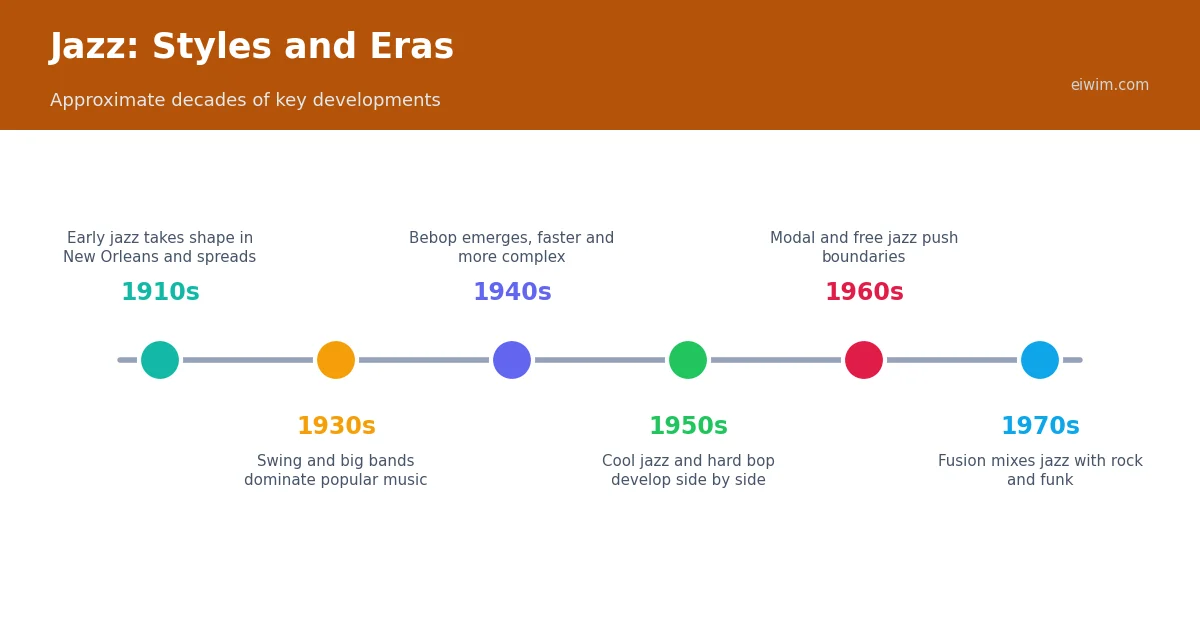
Jazz is a broad word covering more than a century of music. If you open a jazz station without any background, you might hear a bright big band, a fast saxophone solo or a quiet piano trio, all described as jazz. Knowing the main styles helps you find what you like.
Early jazz and swing
Jazz grew from African-American communities in the early twentieth century, with New Orleans often named as an early centre, drawing on blues, ragtime and brass-band traditions. By the 1930s swing and big bands were popular dance music. Swing has a bouncing, steady rhythm and arrangements designed for large ensembles. If you want to explore the era, try the Swing stations.
Bebop
In the 1940s a younger generation of players, including saxophonist Charlie Parker and trumpeter Dizzy Gillespie, developed bebop. It is faster, more complex and meant for listening rather than dancing, with extended improvised solos over tricky chord changes.
Cool jazz and hard bop
Cool jazz emerged in the late 1940s and 1950s with a more relaxed, lightly orchestrated sound, and trumpeter Miles Davis is closely associated with it. At the same time, hard bop kept the energy of bebop but added blues and gospel influences. In 1959 Davis released Kind of Blue, an album built on modal improvisation that is still widely cited as an entry point to jazz.
Free jazz and fusion
In the 1960s some musicians, such as Ornette Coleman, abandoned fixed harmonic structures in favour of free improvisation. In the 1970s fusion combined jazz with rock, funk and electronic instruments, and it brought electric guitars and synthesizers into the mainstream of jazz.
Smooth jazz and modern styles
From the 1980s, smooth jazz offered polished, melodic instrumentals aimed at easy listening. Today jazz continues to mix with hip hop, electronic music and music from around the world.
How to choose a jazz radio station
- For background music while cooking or working, look for stations in Jazz and Easy Listening.
- For vocal standards and classic recordings, try a station that mentions "standards" or "classic" jazz.
- For close listening, choose stations or programmes that play full tracks with presenter notes.
- If you like the blues side of the music, see Blues and Soul.
Jazz also works well as background music for concentration, as we discuss in our post on radio for studying and focus. Browse the full list of styles on the genres page.
The instruments and what each one does
Understanding the roles of jazz instruments makes listening more rewarding. The rhythm section, usually piano, double bass and drums, supplies the pulse and the chords. The bass walks through the chord changes, the drummer keeps time and reacts to the soloists, and the pianist fills in harmony. The front line, such as saxophone, trumpet, trombone or clarinet, carries the melody and takes solos. Guitar can play either role, and the vibraphone and organ appear in many small groups. In big bands, sections of saxophones, trumpets and trombones play arranged parts together, with soloists stepping forward from the group.
Jazz around the world
Jazz started in the United States but quickly became international. European musicians developed their own styles from the 1920s onward, and scenes in Paris, Copenhagen and later Berlin became famous for welcoming visiting players. In Brazil, jazz harmony mixed with samba to produce bossa nova in the late 1950s, which you can explore in the Bossa Nova category. Latin jazz combines jazz improvisation with Afro-Cuban rhythms, and Japan has a devoted jazz audience, with radio and clubs that play both classic recordings and new music. Because jazz is an international language, you can hear it on stations from many countries by browsing the countries page.
How to listen to improvisation
Improvisation is the heart of jazz, but it can be confusing if you do not know what to listen for. Start by recognising the main melody at the beginning of the piece, because the soloists will return to it. During a solo, notice how the player plays with the melody, repeats ideas and builds tension. Pay attention to the other musicians as well, since the bass and drums respond to the soloist in real time, a bit like a conversation. At the end, the group usually returns to the opening melody. Once you can follow this structure, a jazz piece becomes much easier to enjoy.
A jazz listening week
A simple plan helps you explore. On Monday, listen to a general Jazz station and note what you like. On Tuesday, try a Swing station to hear dance-band jazz. On Wednesday, listen to a bebop or hard bop programme for faster, more complex music. On Thursday, try Bossa Nova for a softer sound. On Friday, listen to a live concert recording if a station offers one. At the weekend, pair jazz with Blues to hear how the two styles relate. Our guide to blues radio covers that connection in more detail.
Famous names worth looking up
When a presenter mentions a name, it helps to know where it fits. Louis Armstrong was a defining figure of early jazz, with a trumpet style and voice that shaped popular music. Duke Ellington led one of the great big bands and composed hundreds of pieces. Charlie Parker and Dizzy Gillespie were central to bebop. Miles Davis moved through several styles, including cool jazz and fusion, and his 1959 album Kind of Blue is one of the best-selling jazz records of all time. John Coltrane pushed the music into spiritual and experimental territory, while Ella Fitzgerald and Billie Holiday are among the most admired jazz singers. You do not need to learn all of them, but noting a name that appeals to you gives you something to search for later.
Quick answers
Where should a beginner start with jazz?
Cool jazz and modal jazz, including Miles Davis's Kind of Blue, are widely recommended entry points.
What is the difference between swing and bebop?
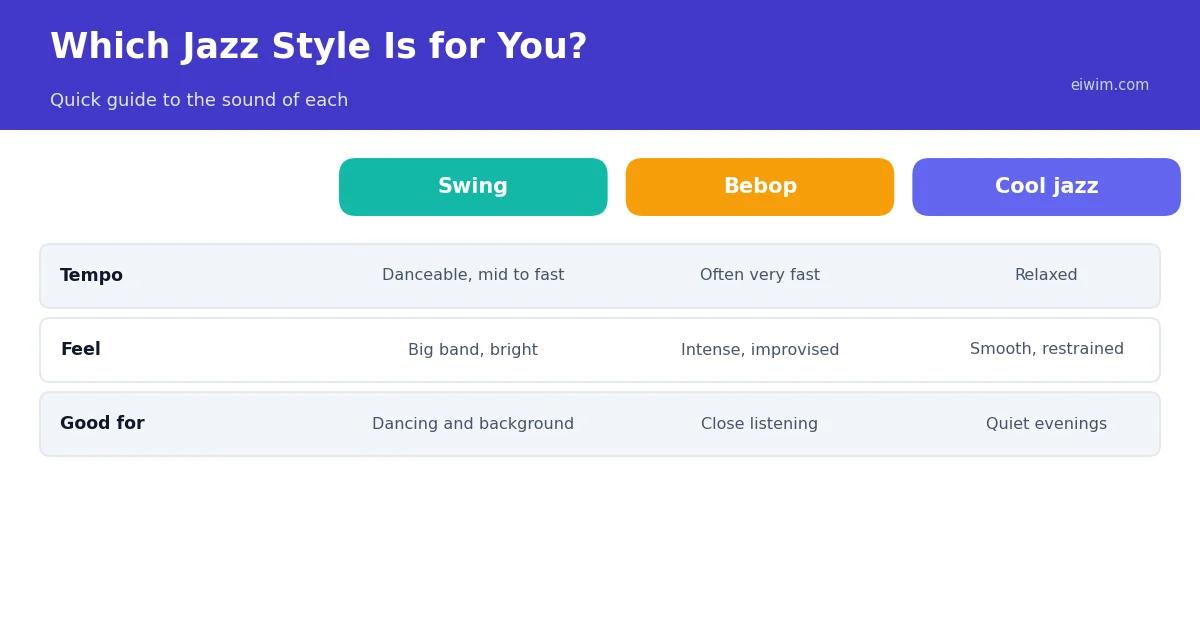
Swing is danceable big-band music. Bebop is faster, more complex and meant for listening.
Is smooth jazz real jazz?
It descends from jazz and fusion but is more polished and melodic. Opinions among fans differ.