A Short History of Radio: From Marconi to Online Streaming
October 02, 2026 · Updated November 02, 2026
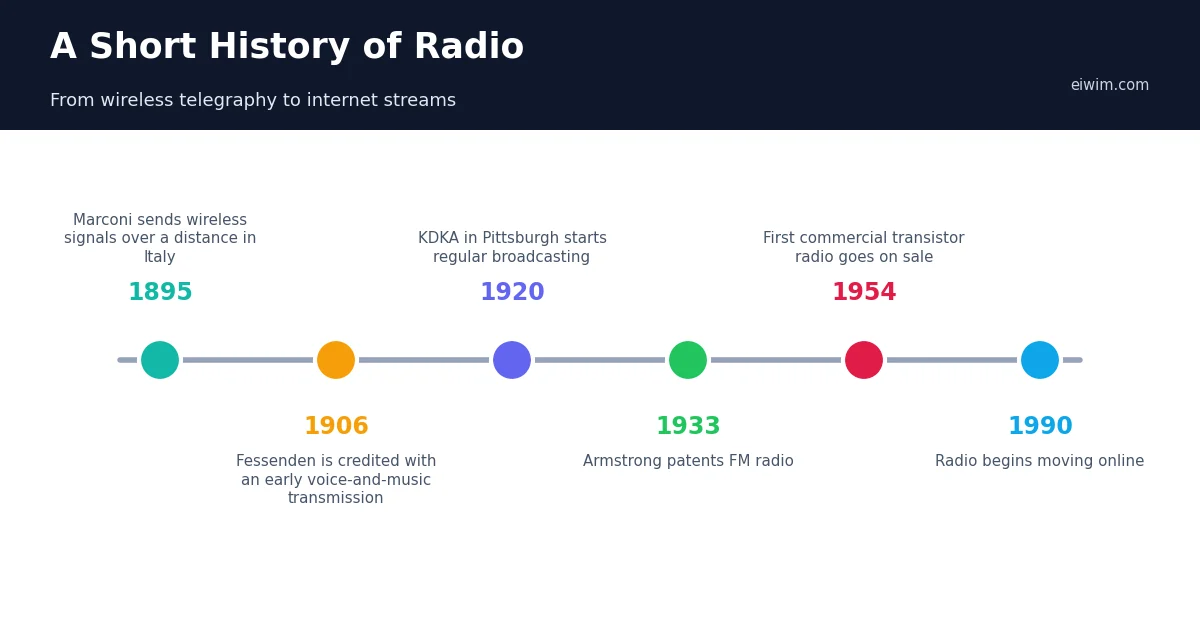
Radio is more than a hundred years old, yet it keeps reinventing itself. Understanding how it developed helps explain why today's stations sound and work the way they do, and why you can now hear a broadcaster from another continent on your phone.
The wireless pioneers
In the mid-1890s the Italian inventor Guglielmo Marconi began sending wireless telegraph signals over increasing distances, and in 1901 he reported a signal sent across the Atlantic. These early transmissions carried Morse code, not speech. In 1906 the Canadian-born inventor Reginald Fessenden is credited with an early transmission of voice and music, showing that radio could carry sound itself.
The first broadcasters
Regular scheduled broadcasting began in the early 1920s. Station KDKA in Pittsburgh started broadcasting in 1920, and in Britain the British Broadcasting Company was formed in 1922 (it became the public British Broadcasting Corporation in 1927). Within a few years, stations were appearing in cities around the world, and radio became a household centrepiece for news, drama, sport and music.
FM and the transistor
Amplitude modulation (AM) was the standard for early broadcasts, but it picked up noise easily. In the 1930s the American engineer Edwin Armstrong patented frequency modulation (FM), which sounds cleaner and supports stereo. If you want the technical details, our guide to AM versus FM explains the difference.
Radios themselves also changed. The first commercial transistor radio went on sale in 1954, replacing bulky valve sets with devices small enough to carry in a pocket. Radio left the living room and moved to the beach, the street and the car.
Digital and online radio
From the 1990s onward, radio began to move to digital platforms. Digital terrestrial formats such as DAB appeared in Europe, and by the late 1990s stations were also streaming over the internet. A listener no longer needed to be inside a transmitter's coverage area. We explain the main digital formats in our guide to DAB and HD Radio, and the basics of streaming in how to listen to radio online.
What stays the same
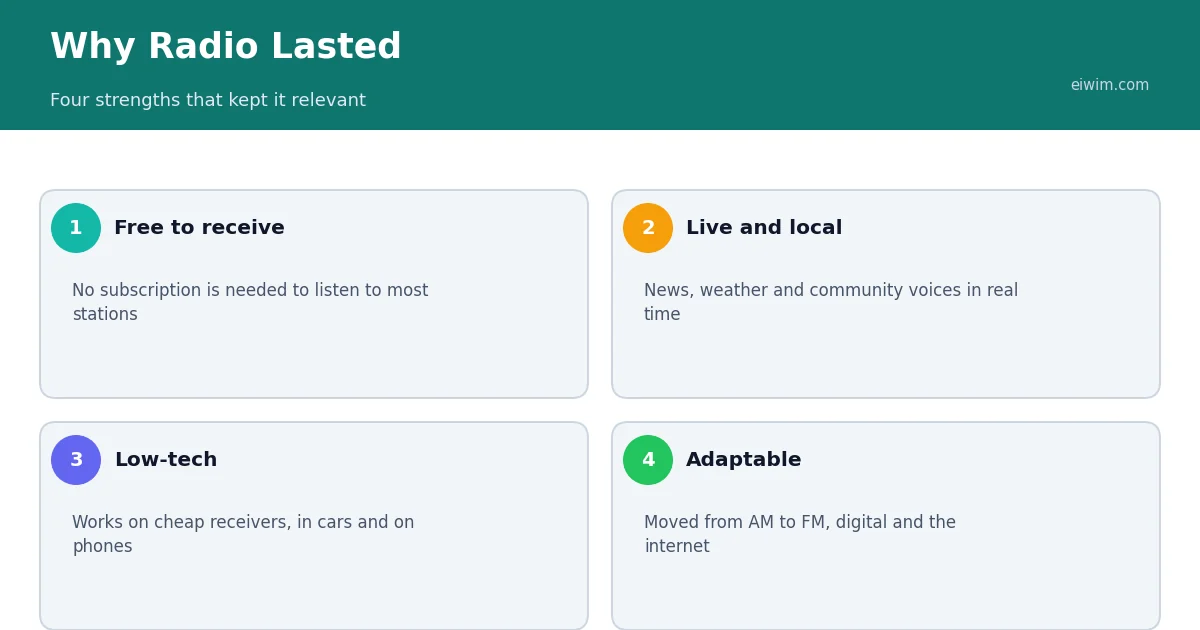
Whatever the technology, radio's appeal has been consistent: it is immediate, personal and usually free. A presenter can react to events as they happen, and a station can reflect the identity of a city or community. That is why you can still find thousands of live stations on Eiwim, from news and talk to every style of music. A good place to start exploring is the countries page or the genres page.
Radio in wartime and everyday life
Radio quickly became a tool of public life. During the First World War, wireless communication was used for military messages, which accelerated the development of better transmitters and receivers. In the 1920s and 1930s, broadcasting moved into homes, and governments realised how powerful it was. Leaders used radio to speak directly to the public. In the United States, President Franklin Roosevelt's "fireside chats", which began in 1933, are a well-known example of how a calm voice on the radio could reach millions of households at once. During the Second World War, radio carried news from the front, official announcements and morale-boosting entertainment, and in many countries people gathered around a single set to hear the latest bulletin.
The golden age of radio drama
Before television, radio was the main form of home entertainment. Stations broadcast comedies, detective stories, adventure serials, quiz shows and dramas, with sound effects and music creating pictures in the listener's imagination. One famous example is the 1938 broadcast of "The War of the Worlds" by Orson Welles and his company, which presented a science fiction story in the form of news bulletins and reportedly alarmed some listeners who tuned in late. Whatever the exact reaction, the episode shows how convincing radio could be. Many radio dramas are still available today, and some stations specialise in them.
Television and the reinvention of radio
When television spread in the 1950s, many predicted that radio would disappear. Instead, radio changed. Drama and big variety shows moved to the screen, and radio became a source of music, news and personality. Disc jockeys became stars, car radios became common and the transistor made radios cheap and portable. Young people carried their music with them for the first time. This is also the period in which formats such as Top 40 took shape, as explained in our guide to how charts shape playlists.
Radio around the world today
Today radio exists in many forms. Public broadcasters provide news and cultural programming, commercial stations rely on advertising and community stations serve local audiences. Shortwave broadcasts still reach remote areas and travellers, digital systems such as DAB offer clear sound, and internet streams let listeners hear stations from any country. Although the technology has changed enormously, the basic pleasure of a voice and a song arriving as you listen has hardly changed at all. You can try it yourself by browsing stations on the countries page, then compare how different regions use the medium.
Why the history matters for listeners
Knowing the story helps explain what you hear today. The split between AM and FM comes from the 1930s. The idea of a "format", such as news or Top 40, comes from the competitive years after television arrived. Public and commercial broadcasting differ because governments and businesses made different choices about how to fund a medium that everyone could receive. Even the habit of listening in the car, kitchen or workshop dates from the portable era. Understanding these origins makes it easier to choose between a public broadcaster, a commercial hits station and a community channel, and it shows why internet radio, with its endless choice, feels like a new chapter rather than a replacement. For a closer look at the economics, see how radio stations make money.
Quick answers
Who invented radio?
No single person did. Marconi turned wireless telegraphy into a commercial system in the 1890s, and many others, including Fessenden and Armstrong, added key advances.
When did regular radio broadcasting start?
Regular scheduled broadcasts began in the early 1920s, with stations such as KDKA in the United States and the British Broadcasting Company in 1922.
Is radio still relevant today?
Yes. Radio is free, live and available on phones, in cars and online, so it keeps its place for news, music and company.