Radio in Germany: Public Broadcasters, Schlager and Online-Only Stations
October 16, 2026 · Updated November 02, 2026
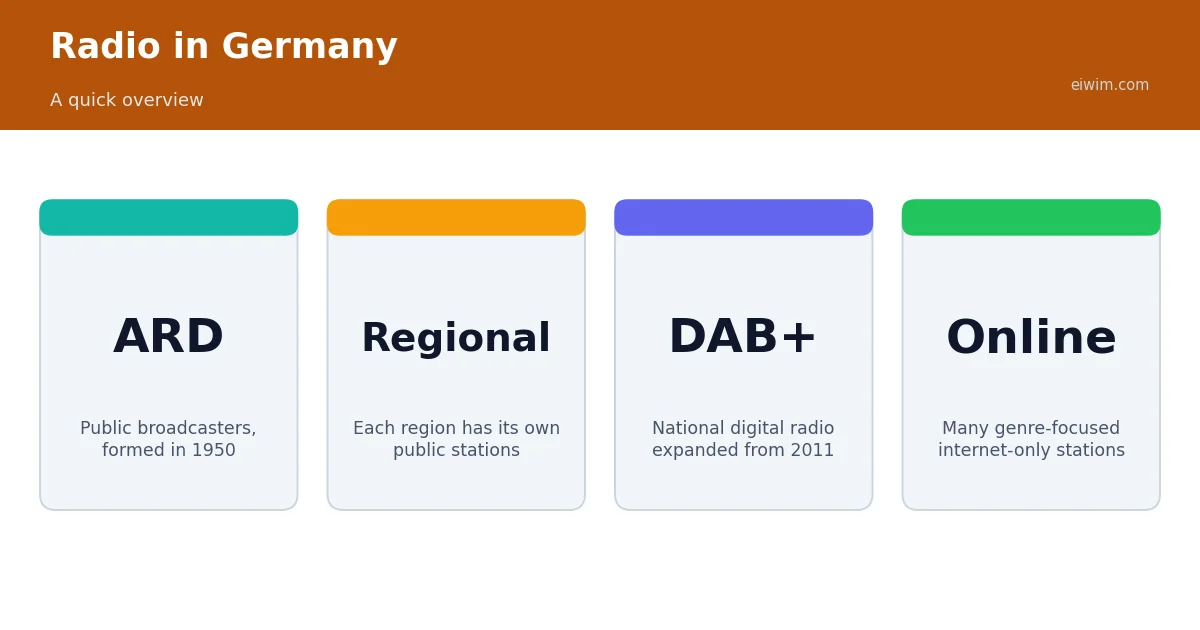
Germany is one of the world's largest radio markets, and the number of stations available online is huge. Here is a simple way to understand how German radio is organised and what to try first.
Public broadcasters
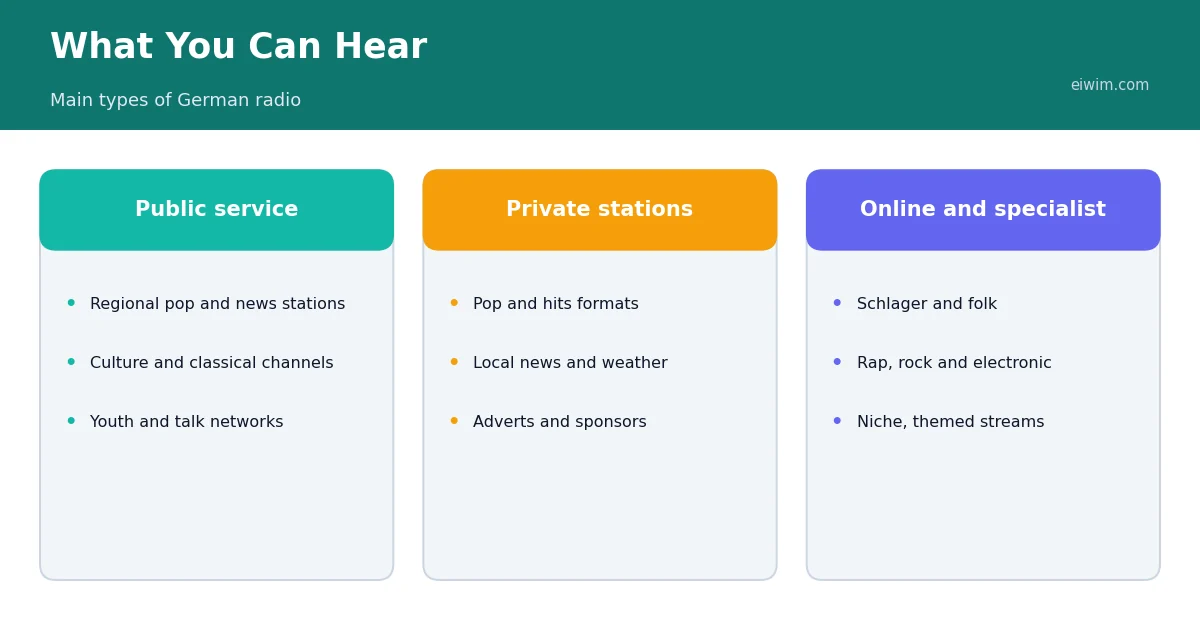
German public broadcasting is organised regionally. The ARD, founded in 1950, is an association of regional broadcasters, each of which runs several radio stations for its area, usually including a pop station, a news and information station, a culture channel and a youth station. At the national level, Deutschlandradio runs Deutschlandfunk and related channels, and Deutsche Welle (founded 1953) broadcasts internationally. Public stations are funded mainly by a household contribution, and they carry less advertising than private stations.
Private stations
Private radio has been permitted alongside public radio since the mid-1980s. Commercial stations usually focus on pop, hits and local news, and they rely on advertising. Many belong to networks that share programming across regions.
Digital and online
Germany has expanded DAB+ digital radio since a national service began in 2011, and online listening is widespread. The internet has also produced a wide range of online-only stations, many focused on a single genre or era. On Eiwim, the Germany page lists more than two thousand stations. For the technology behind digital radio, see our DAB+ and HD Radio guide.
Music styles to know
- Schlager: German-language popular music with simple melodies and singalong choruses. Browse Schlager and Discofox.
- German folk music: traditional and popular folk music from German-speaking regions. See German Folklore.
- Rap, rock and electronic: Germany has a strong presence in all three. Try Rap, Rock and Techno. Techno and trance both have deep roots in German clubs, as described in our electronic music guide.
- Pop and hits: the Pop and Hits categories include many mainstream stations.
Language note
Most stations broadcast in German, but you will also find stations in other languages, including Turkish, English and Russian, serving communities across the country. Some use Swiss German, listed separately on the languages page.
Listening tips
- For news in clear standard German, try public regional news stations.
- For language learning, follow the approach in our language learning guide.
- For music variety, pick a genre-specific online station and explore related genres.
Meet the regional public broadcasters
German public radio is organised through ARD, an association of regional broadcasters. Its members include Bayerischer Rundfunk (BR) in Bavaria, Norddeutscher Rundfunk (NDR) in the north, Westdeutscher Rundfunk (WDR) in North Rhine-Westphalia, Südwestdeutscher Rundfunk (SWR) in the south-west, Hessischer Rundfunk (HR), Mitteldeutscher Rundfunk (MDR), Rundfunk Berlin-Brandenburg (RBB), Saarländischer Rundfunk (SR) and Radio Bremen. Each runs several radio channels for its region, usually with a mix of pop, culture, news and youth programming. National channels, such as those run by Deutschlandradio, add news and cultural content for the whole country.
Regional private radio
Private stations are licensed and supervised by regional media authorities. Many serve a single state or city and mix music with news, traffic and local events. Because the licensing is regional, you will often find several commercial stations that sound similar but target different areas. This is one reason Germany appears so high in directory statistics. If you want to compare, browse stations from Germany and note how many carry the name of a region or city.
German music beyond schlager
Schlager is only one strand of German music. In the 1970s, experimental bands associated with the term krautrock mixed rock with electronic textures and long improvisations, influencing later electronic and alternative music. In the early 1980s the "Neue Deutsche Welle", or German new wave, brought quirky, synthesizer-driven pop sung in German. After reunification, Berlin became a world centre for techno and club music, and the country has a thriving hip hop scene. You can explore these on Electro, Techno, HipHop and Rock stations, as well as on the classic Schlager and German Folklore categories. For the electronic side, see electronic music genres explained.
Using German radio to learn the language
German radio is an excellent resource for learners. News bulletins use clear, standard German, which is easy to follow once you know a few hundred words. Music stations let you hear everyday expressions, and many presenters speak slowly enough to be understood. A useful method is to listen to one short bulletin each day, write down five words you did not know and look them up. Our guide to learning a language with online radio gives a step-by-step plan. You can also browse stations in German to find stations from Austria and Switzerland, which add other accents.
A small German listening plan
If you want to explore German radio in a structured way, try a week-long plan. On the first day, listen to a regional public station to hear typical morning programming. On the second, choose a national news station and note the vocabulary used for politics and weather. On the third, sample Schlager to hear the language in song form. On the fourth, listen to a Rock or Pop station to compare how Germans mix English and German. On the fifth, try German Folklore for regional traditions. On the sixth, explore Techno or Electro to hear Berlin-style club music. On the seventh, repeat the station you liked best and listen with a notebook. By the end of the week you will have heard a wide cross-section of what German radio offers, and you can read our overview of how stations are funded to understand why public and commercial channels sound different.
Tips for non-German speakers
You do not need to speak German to enjoy German radio. Music stations are easy to appreciate for their sound alone, and many songs mix English and German lyrics. Station names and presenters often use simple, repeated phrases that you can pick up quickly. If you are learning, notice how the same greetings and weather words appear every day. A bilingual dictionary on your phone is enough to look up a few words after each session. Regular, short listening periods are far more effective than occasional long ones.
Quick answers
What is Schlager?
German-language popular music with simple melodies and singalong choruses.
How is German public radio organised?
Regionally, through the ARD broadcasters, plus national channels from Deutschlandradio.
Is German radio good for learning German?
Yes. News on public stations is a clear, structured starting point.